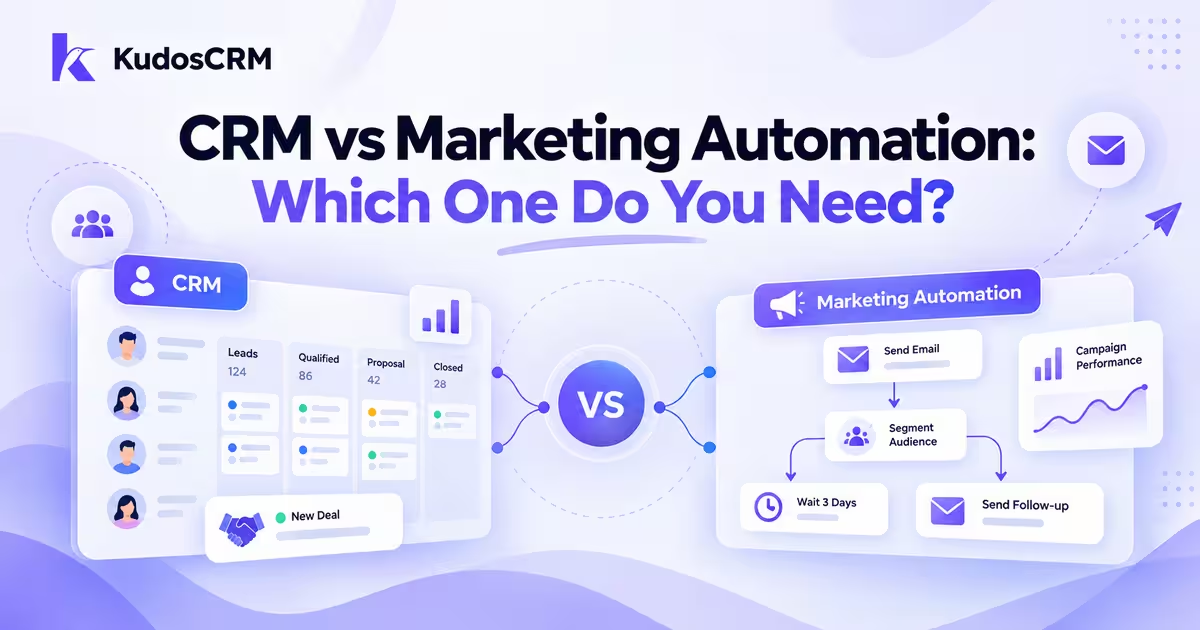

Picture an SMB with 3,000 contacts, one marketer, and two open tabs: a CRM signup page and a marketing automation platform, both asking for a credit card. The founder just wants to know whether one subscription can do the work of two. That is the real crm vs marketing automation question, and most comparison articles dodge it by declaring the tools "complementary" and telling you to buy both.
They are complementary. But that answer skips the decision you actually face: where the two tools hand off, and whether your contact volume justifies paying for two systems at all. A CRM manages customer relationships, sales activities, and revenue opportunities. Marketing automation manages lead nurturing, campaigns, and behavior-based customer journeys. Many businesses start with a CRM that includes automation features and add dedicated marketing automation software only when their marketing processes require more advanced segmentation and workflows.
The core job each tool is hired to do
Strip away the feature lists, and each tool answers a different question. A CRM asks what is happening with the people you already know by name. A marketing automation platform asks how you move thousands of people you barely know one step closer, without a human touching each one.
CRM: managing named relationships from first call to close
A CRM is the system of record for identified contacts and the deals attached to them. It holds the company, the contact, the open opportunity, the call notes, the next task. Its job is to organize customer information, sales activities, conversations, and opportunities throughout the customer relationship. We go deeper on the category in what CRM software is, so the point here is narrow: the CRM governs the relationship, not the campaign.
Marketing automation: nurturing prospects through automated journeys
A marketing automation (MA) platform runs behavior-triggered journeys across email, forms, and landing pages for large audiences that require automated, behavior-based communication. Someone downloads a guide, and the platform drops them into a nurture sequence; they hit the pricing page twice and their score ticks up. Think of the CRM as a ledger of relationships and the MA platform as a switchboard, routing thousands of small automated touches based on what each person just did.
ESP, marketing automation, and native CRM email do different jobs
Most comparison pages treat "email marketing" and "marketing automation" as the same thing. They are not, and the distinction decides what you actually need to buy.
An email service provider (ESP) is mainly designed for sending scheduled campaigns and newsletters, while marketing automation focuses on triggered, multi-step journeys based on customer actions. A marketing automation platform triggers multi-step journeys off behavior: open this, wait two days, branch if they clicked. Native CRM email sequences are yet another distinct job: the one-to-one, rep-owned follow-ups that read like a personal note rather than a campaign.
Our sequences vs campaigns breakdown pulls these apart in detail. Conflate them, and you either overpay for automation you never use or underpower a nurture program that needs real branching. (If you are specifically weighing which CRMs handle bulk email best, we rank those separately in best CRM for email marketing.)
CRM vs marketing automation across five dimensions
Dimension | CRM | Marketing automation |
|---|---|---|
Audience scope | Named, known contacts and active deals | Anonymous and pre-conversion audiences at volume |
Data model | Records: contacts, companies, deals, activities | Lists and segments keyed to behavior |
Primary channel | Rep conversations, calls, one-to-one email | Multi-step email, forms, landing pages, ads |
Team owner | Sales and account management | Marketing and demand generation |
Success metric | Pipeline created, win rate, revenue closed | Leads generated, engagement, cost per lead |
The CRM vs marketing automation split is really this: the two systems own different halves of the funnel and hand off in the middle.
Where the two tools overlap
Two capabilities live in both systems, and that overlap is where most two-tool stacks start to leak.
The handoff point: MQL to SQL
The functional boundary between the two tools is a specific event: the MQL-to-SQL conversion. Marketing automation owns the lead while it is a marketing-qualified lead (MQL), running the nurture. The CRM takes over the instant that lead becomes a sales-qualified lead (SQL) and lands in a rep's pipeline.
Make it concrete. In B2B SaaS, the MA platform runs the post-webinar follow-up drip: three emails, a case study, a soft demo offer. The handoff fires the moment a rep books a discovery call. Before that call, the contact belongs to marketing's automation; after it, to the CRM's pipeline. Leave that trigger undefined and leads sit in limbo, nurtured by nobody and worked by nobody.
When behavioral scores and fit scores collide
Both tools score leads, and they score different things. MA scores behavior: opens, page visits, form fills. The CRM scores fit: job title, company size, rep-observed buying signals. Run both without a sync rule, and you get the classic failure: a contact with a soaring behavioral score but poor fit, say a student downloading everything for a class project, gets routed to a rep who burns a call on someone who will never buy. The fix is a combined gate: a lead becomes an SQL only when it clears a behavioral threshold and a fit threshold together. Our lead scoring approach builds that combined gate in one place instead of two systems arguing about it.
When a dedicated marketing automation platform earns its keep
What HubSpot, Marketo, and ActiveCampaign optimize for
The major platforms are built for high-volume, multi-channel nurture, and each leans a different way:
HubSpot Marketing Hub: starts at around $890/month and includes three core seats, with additional costs depending on contacts and requirements.
Marketo Engage (Adobe): enterprise demand generation, deep segmentation, built for very large databases and complex programs. Pricing sits at the enterprise end and climbs steeply with database size.
ActiveCampaign: SMB-friendly automation with genuinely capable email journey logic. The Pro plan starts at $99 per month for up to 1,000 contacts.
Pardot / Salesforce Marketing Cloud: B2B automation tuned to sit inside the Salesforce ecosystem.
Every one of them is optimized for orchestrating many automated touches across a big audience, not for managing a rep's twenty open deals.
The contact-volume threshold that flips the math
Contact volume influences the decision, but it is not the only factor. A CRM with native automation can often support businesses with straightforward nurture campaigns, sales follow-ups, and limited segmentation needs. A dedicated marketing automation platform becomes more valuable when teams need advanced segmentation, complex customer journeys, multi-channel campaigns, or deeper marketing attribution.
When a CRM with native automation covers both jobs
When automation and pipeline share one data model, the seams disappear. A single record holds the campaign history and the deal, so scoring, sequences, and reporting all read from the same contact. Our CRM automation and workflows pages show what that looks like in practice, and audiences plus email sequences cover the nurture side.
Staying in one system also deletes two problems that only exist in split stacks. Integration complexity is the first challenge. When CRM and marketing automation platforms are separated, teams must maintain data syncing, field mapping, duplicate management, and reporting consistency across multiple systems. Deduplication is the second, and it compounds. Two systems syncing imperfectly spawn duplicate records that someone has to merge by hand, every week, indefinitely. Live in one system and neither problem is yours.
Why B2B and B2C land on different answers
Business model, not company size, decides how much automation you need. A B2B sales engagement strategy runs on a smaller set of named accounts a rep works directly, so the CRM does the heavy lifting and native automation covers the nurture. B2C flips that calculus entirely.
High-volume, behavior-triggered flows are the entire game in consumer commerce. Abandoned-cart email is the clearest case: According to Klaviyo's 2024 benchmark analysis of more than 143,000 abandoned-cart flows, these automated emails recorded a 50.5% average open rate and a 3.33% placed-order conversion rate. Browse-abandonment flows follow the same logic, firing within minutes when a visitor leaves a product or category page without converting. Both are purpose-built MA jobs: anonymous-to-known, triggered by behavior, at a volume no sales team could ever work by hand. A sales-first CRM is simply not designed for either.
What a two-tool stack actually costs
Marketing automation pricing varies based on contacts, features, and plan structure. Platforms such as ActiveCampaign, HubSpot Marketing Hub, and Marketo use different pricing models based on business requirements. HubSpot. Marketo Engage sits at the enterprise end, with pricing that climbs steeply as the database grows. Pair a mid-tier platform like HubSpot with a CRM and its per-seat cost (covered in detail in our CRM pricing guide), and the marketing side of the stack alone runs well into five figures annually, before you count the sales seats beside it.
For context, a CRM with native automation built into the same platform typically covers both jobs at a fraction of that figure for teams under 5,000 contacts, which is why the integrated path is often the right starting point before the contact volume or journey complexity actually demands two systems.
The costs that never reach the invoice are the ones that compound. Poor CRM data cleansing practices can create duplicate contact records that teams must continuously identify, merge, and maintain across systems. The attribution gap is the second. A deal closes in the CRM while the campaign that sourced it lives only in the MA platform, so you can never cleanly tie the revenue back to the program that earned it. Split contact data across two systems and you keep paying that tax every quarter.
Three questions that decide your setup
The CRM vs marketing automation decision usually resolves once you answer three questions.
How many contacts are in active behavioral nurture, not merely stored? Under a few thousand, native CRM automation is enough. Is your motion sales-led or marketing-led? Sales-led leans CRM; marketing-led raises the case for a dedicated platform. Are your journeys multi-step and behavior-triggered, or broadcast plus rep follow-up? The first needs real automation; the second does not.
Map those answers onto three buyer segments:
A sales-led SMB with a manageable contact database can often start with a CRM that includes automation features. A separate marketing automation platform becomes useful when marketing operations become more complex.
A marketing-led SMB with mixed inbound volume should start on native CRM automation and add a dedicated MA platform only once marketing campaigns require more advanced segmentation, testing, and journey management. Buy the second tool when you feel the ceiling, not before.
A high-volume B2C business or enterprise managing large audiences may benefit from dedicated marketing automation because these platforms are designed for complex, behavior-driven customer journeys at scale. At that scale, the orchestration justifies every line of the bill, and the attribution work becomes a project you staff rather than a problem you tolerate.